
End of Year Newsletter 2025
It has been a couple months since my last newsletter, and for that I apologize. I’ve been working hard on legislation and trying to be in every place I can be so that I can deliver results for the residents of the 9th ward and the city. As the year draws to a close, I’d like to highlight some of my office’s accomplishments this year, as well as what you can expect out of me in the coming year.
Election Code Reform: (Board Bill 88)
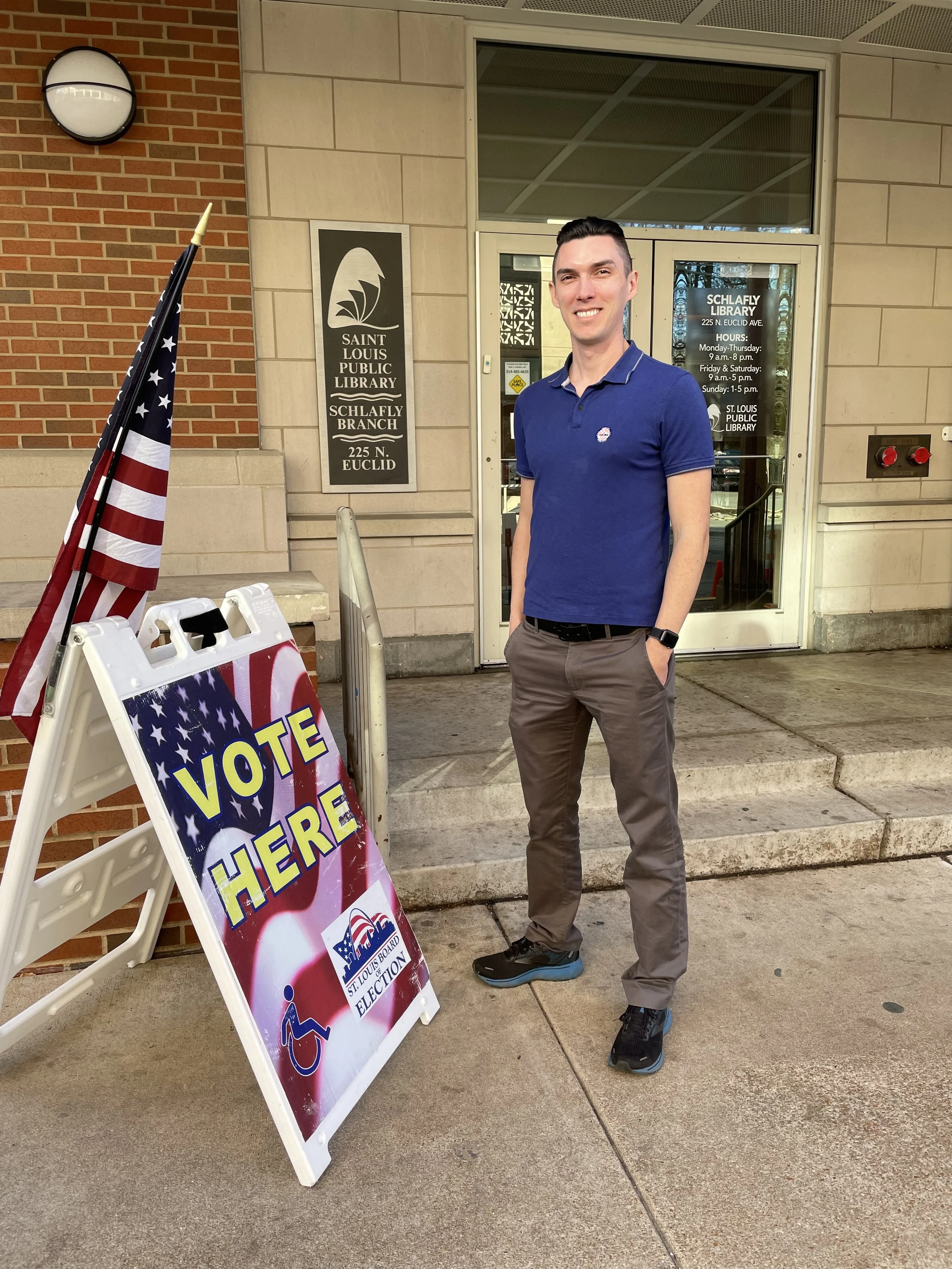
Elections are where the rubber hits the road when it comes to democracy, and local elections are the purest distillation of the lofty promise of government by the people. But in St. Louis, our election code had become incredibly inconsistent and outdated.
Reform started with a simple notion: that income shouldn’t be a barrier to filing for office. After the consolidation of the Board from 28 alders down to 14, the salary for Alderman doubled. It was an overdue salary boost, allowing people like myself to commit to doing this job full time. But with the salary boost came an inadvertent doubling of the filing fee, which was set at 1% of the salary. That made it cost over $700 to file for alder, and over $1,000 to file for Mayor, Comptroller, and President of the Board.
That’s more than any other local or state office. For $500, you can even run for US Senate. Last session and earlier this session, I introduced bills to lower the filing fees for the local offices, but they both failed in committee.
My passion for this issue is rooted in my commitment to democracy, so I came back and tried again, this time taking on the whole election code. Last revised in the 1950’s, Title 2 of the City’s Municipal Code was in need of an update. Ordinance after ordinance had added language but no one ever went back and cleaned up the contradictions and inconsistencies. This led to a confusing, hard to understand code, and in the worst case scenario, lawsuits around our elections, costing taxpayer money to resolve.
BB88 started as a way to make sure we had better representation, but it grew into a comprehensive update. A lower filing fee opens the door to more people running for office from different walks of life, giving voters a chance to engage with different ideas and hopes for our city. Having choices is a good thing in democracy, and the advantage of non-partisan approval voting, our city’s method of voting, is that the candidates earning first and second place move on to the general, giving voters a choice between the two most popular candidates regardless of party. The system works best when there are three or more candidates to choose from in the primary.
BB88 lowers the filing fee, but leaves in place the requirement to gather signatures in order to earn a place on the ballot, ensuring that candidates have to get out and talk to voters. The new filing fee is $100 for Alder and $250 for the citywide offices of Mayor, Comptroller, and President of the Board. This board bill also clarifies what happens in the rare event of a tie, brings back two-person primaries, and allows voters to sign more than one petition for candidacy. With approval voting, you’re allowed to vote for more than one person in the primary, so it makes sense to be able to endorse more than one candidate to be on the ballot. The bill also strengthens the process for ensuring all candidates have paid their taxes, eliminates old defunct code, and reorders the election process into chronological order for ease of reading.
This election update will not change how you vote, other than the possible return of a two-person primary, which won’t cost the City any extra money and would not apply in Special Elections, which still use traditional Party primaries. Changing that would require a charter change, and was not something that could be updated in this bill. But there is value in a primary even when both candidates are guaranteed to advance to the general election, both in voter familiarity and encouragement to engage with races up and down the ballot. In the last election, where I was unopposed, I had voters approach me after voting in the primary and ask why I wasn’t on the ballot. In the future, it is my hope that the lower filing fee will give voters more choices in the primary, and we will see fewer two-person primaries and fewer unopposed races.
After a lot of engagement with fellow alders and groups like the League of Women Voters, BB88 became a strong, comprehensive update to our election code, ensuring fairness in our elections, clarity in the processes, and modernization of our code. I owe a big thank you to the Board of Elections for their collaboration to make sure the code is as strong as possible. Working with them felt like doing the work behind democracy, the work that is required to keep it.
Addressing Vacancy: Board Bills 169, 170, and 171 (from 24-25 session)
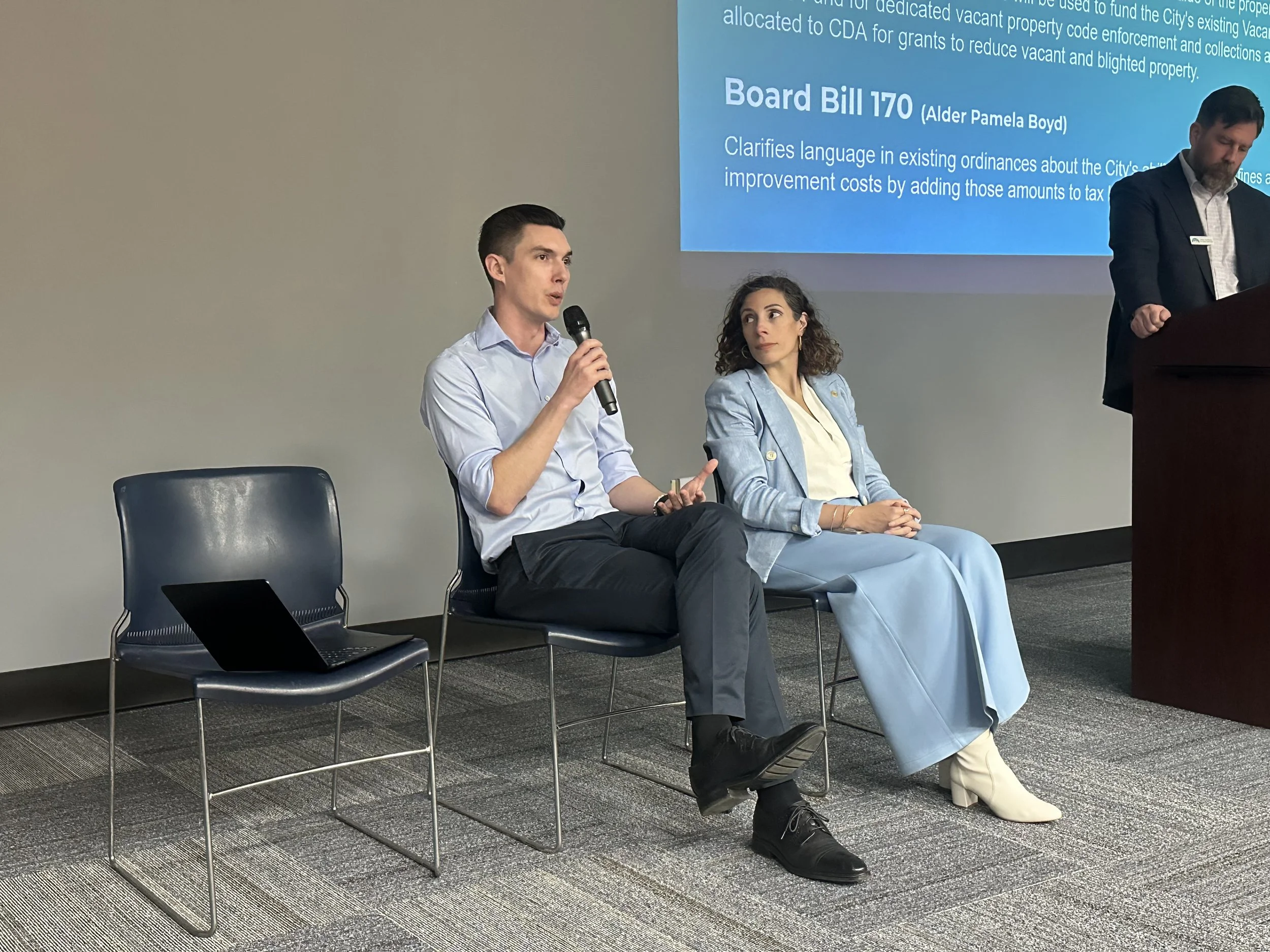
Our city has a vacancy problem. It also has some of the most beautiful brick buildings in the country. They could be someone’s home or business, but when they sit empty, they hurt their neighborhoods and require extra city services. When we can’t rehab them in time, we lose too many buildings to weather, fire, and neglect. The City needed new tools to tackle this problem, so at the end of last session, early in 2025, I was the sponsor of one of three bills that may end up being some of the most impactful pieces of legislation passed this year.
A coalition of alders, representing North, Central and South city, sponsored Board Bills 169 (Browning), 170 (Velazquez), and 171 (Boyd). These bills updated the fines and fees for vacant and deteriorating properties, added fees for board ups and illegal demolition, and added the ability to put those fines and fees onto a special tax bill, due within a year. They also established the Vacant Building Initiative Fund, putting the collected fines and fees into an account that the Building Division can use to put more inspectors on the street.
Previously, administrative citation fines for code violations on a property were $25 for the first citation, and $50 for the second. These incredibly low fines did little to motivate negligent property owners to fix up their properties. Board Bill 169 changed that, increasing the fines to $100 for the first violation, $250 for the second, and $500 for third and subsequent violations. Board Bill 171 allows those fines to go onto a special tax bill, collectable within one year rather than three years under the normal property tax process. Board Bill 170 made the penalties stiffer for illegally demolishing a building, slapping a $30,000 fine, or one half of the appraised value of the building, whichever is greater, on anyone who demos without a permit.
I’m incredibly proud of these bills, and of my Legislative Assistant, Kaitlyn, for taking the initiative to turn a memorandum from Legal Services of Eastern Missouri (LSEM) into this legislation. This progress for the City is thanks to the hard work and dedication of Peter Hoffman and his team at LSEM, who put in over one hundred staff hours on these strategies to address vacancy, as well as the Vacancy Collaborative, whose work continues to benefit St. Louis.
None of this would have been possible with you, the voters, who passed Prop V in November 2024, a charter amendment that took the cap off of fines and fees for vacant properties. Together, these bills provide new tools to the City in combatting demolition by neglect, motivating negligent property owners to fix up their properties or sell them to someone who will. It is my hope that we will be able to save more of our beautiful historic housing, bring old vacants back from the brink, and breathe new life into our city. I have already seen some vacant buildings hit the market in the 9th ward, a sign that these policies may already be having an effect.
Keeping C2N Diagnostics in St. Louis City: Board Bill 139
C2N Diagnostics is doing something incredible: the company is developing a test that measures the efficacy of drugs that treat Alzheimer's and other neurodegenerative diseases. A start-up that grew out of Washington University’s research labs, C2N was expanding and needed a new home. The decision was coming down to two cities, St. Louis or Denver. The company needed lab space that would enable it to do its cutting-edge work, and St. Louis didn’t have the kind of space needed to keep this exciting homegrown company here. That’s where Board Bill 139 came in to help build out the company’s space in the former Goodwill building at 4140 Forest Park Avenue. Board Bill 139 gave a personal property tax abatement on the equipment that will be furnishing this brand new, modern lab space that will allow C2N to triple its footprint in St. Louis.
Due to move into the building in 2026, C2N’s corporate headquarters is going to occupy 82,451 square feet of the 163,000 square foot building. The rest of this historic building is being built out by Washington University to provide landing spots for future St. Louis startups. The overall project, a $100 million revamp, is sure to produce many more headlines over the next several years. For St. Louis, it means good paying jobs, and the chance to keep a home-grown company here in the city. For the world, C2N means exciting progress on neurological diseases that have taken too much from too many. When this kind of amazing work can happen right here in St. Louis City, I am humbled to have played a small part in supporting it.
2026: What’s On the Radar
Legislative agendas are not written in stone for a reason. 2025 has been one of those years that proves that the best laid plans often go awry. The May 16th tornado was devastating to many in our community. It shook up this year’s legislative agenda too, as the Board of Aldermen pivoted towards focusing our energy on disaster relief. On that note, expect to see more infrastructure repairs around the tornado-stricken parts of the Central West End in 2026, including sidewalk repair and replacement. I always fully fund the planting of 200 new trees in the ward every year and this coming year I will be asking the Forestry Division how I can help facilitate the planting of more trees in areas that lost a significant amount of canopy.
As for legislation, here are some of the things I’m looking at for the new year. It’s not an exhaustive list, but I hope you see some things that matter to you. If you don’t, there may be a reason for that. Just ask me, and I’ll let you know what’s going on. Or come to my next town hall. I will announce the date, time and location soon…
Water
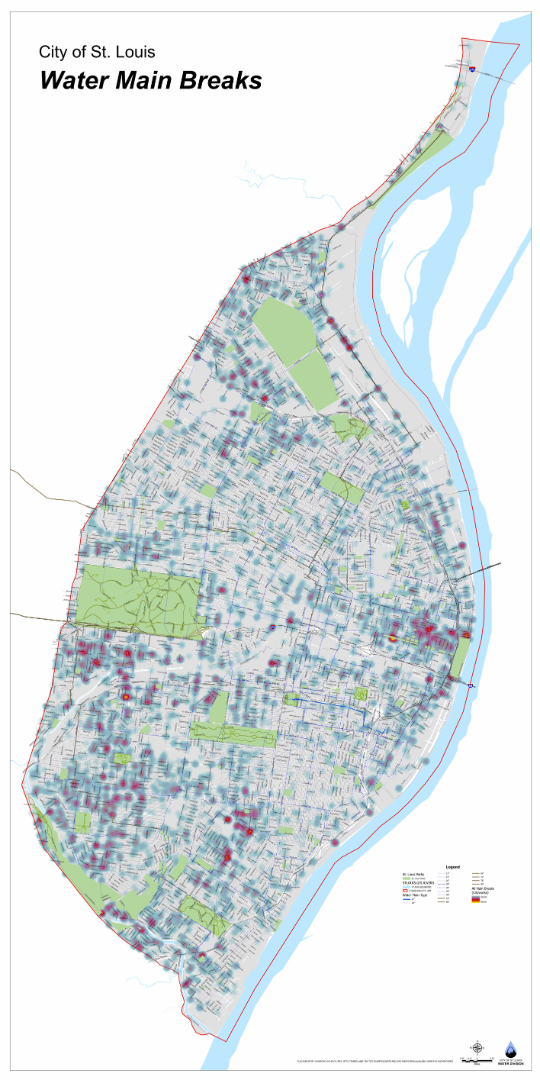
Our Water Division is in crisis, and the can has been kicked down the road for far too long. In 2025 there have been 374 breaks in the network of pipes that make up our system. In 2024, there were 329. When looking at a heat map of the breaks, they are everywhere that we have pipes.
The Water Division is responsible for the safe, clean drinking water that is delivered to our taps. It is an enterprise fund, meaning that its only source of income is found in the rates that it charges its customers. Those rates barely pay for the daily operation of the Water Division, and costs keep going up. But the rates you pay do not replenish the contingency fund, which was largely drained during COVID, or provide funds for infrastructure repair and replacement. The Water Division estimates that it has $150-200 million in capital repairs that are needed. I will be looking to make sure at least some of the Rams Settlement money goes to the long-neglected Water Division so that we can keep our water safe, clean, publicly-owned, and affordable.
Department of Transportation
In November 2024, voters approved Prop T with almost 90% of the vote. Prop T changed the City’s charter and created a Department of Transportation, effective July 1st, 2029. Over the next few years, I will be working to ensure the policy, funding, and personnel needs of this department are met, as it will be responsible for both the maintenance and safety of our streets and sidewalks. What will that look like?
I already introduced one related bill last session, Board Bill 127, which would take speed humps and stop signs out of aldermanic control and put it in the hands of the department. I’ll be bringing that concept back in some form, as it is important to professionalize traffic calming so that it is applied strategically and to the greatest effect, making our streets safer wherever they need improvement. Speed humps are effective, but not always the best solution.
The Department of Transportation will need funding, and the plan is to take a close look at ward capital and STL Works, two existing taxes, as sources of funds. Currently, alderpeople decide which streets get paved by allocating funds from ward capital and STL Works. A truly functional DOT should be able to effectively plan and implement street maintenance and improvement according to need without depending on aldermanic support and funding. It is only then that the City can have a paving plan, where streets are paved according to a schedule that is publicly available, so residents (and utility companies) can know what’s getting paved next.
Planning is perhaps the most important piece of the Department of Transportation. Without a planning staff, the department will not be capable of much more than it currently is as the Department of Streets. The change to the charter specifically added planning to the department’s description, because proactive street maintenance and improvement is not possible without planning. From everything to coordinating with utilities so our streets aren’t torn up after being recently repaved, to making sure traffic calming addresses the most dangerous places in our city, planning is at the heart of decision making that can make our streets safer, better maintained, and ensure the equitable allocation of our resources. I am open to what that structure looks like in the new DOT, and look forward to working with the Mayor’s Office and the rest of the Board to make sure this department makes a tangible difference in our city.
Development
St. Louis needs to continue improving its city services, and those changes cannot happen through legislation alone. It is critical that our City focus on building our tax base so that we can afford to pay our workers competitively and deliver excellent city services that our residents deserve. That’s where development of new housing, new job opportunities, and new commerce is vital to the future of St. Louis.
Vacant buildings are both detrimental to neighboring properties and are a drain on city resources. Where the city can help save beautiful old buildings, it should work with both a carrot and a stick to make sure we aren’t losing them to fire or neglect. Where the city has opportunity, we should be proactive in making projects work where they are possible. Next year, I have my sights set on a few vacant buildings in the ward, and I intend to do what I can to help the City grow.
The Optimist Club building at Taylor and Lindell is one building I have on my radar. As a non-profit it does not pay property taxes to the city, and the building is expensive to maintain for its current occupant, a children’s charity, Optimists International. I will be looking to see how we can turn this site into a benefit for the city and the neighborhood. The Engineer’s Club at 4359 Lindell is in a similar situation, and I have a board bill set for introduction to help facilitate development at that site, also owned by a non-profit.
The old Royal Oaks Nursing Home, located at 4960 Laclede, has become a dangerous situation and a detriment to the surrounding neighborhood. It is important to preserve our City’s beautiful buildings, but this one’s history was not kind to it, and it has become a major problem that needs a solution sooner than later. I will be working to find one, as it is only a matter of time before someone gets hurt.
On a related note, the houses on Manchester Avenue, right as you enter The Grove from the West, are looking worse every day. On one of them, no matter which angle you look at it, you can see straight through. I am working on securing an emergency demolition to eliminate the danger and the eyesore that these properties have become. I hope to see the worst of these structures demolished soon. The Grove and the surrounding Forest Park Southeast neighborhood have made so much progress, and these buildings do not reflect the success story of this great neighborhood.
Traffic Safety
Lindell Boulevard
For those who were able to make it to the Lindell Redesign Open House in November, you saw the work that the City and I are doing to improve Lindell Blvd. In 2026, we will be applying for funding to make that project a reality.

Chouteau Avenue
Also in 2026, we will host an open house for the redesign of Chouteau Avenue between Sarah and Taylor.
Vandeventer Avenue and Sarah Street
Phase II of the Tower Grove Connector will kick off in the 9th ward, narrowing Vandeventer down to two lanes and continuing the cycle-track that is nearing completion on Tower Grove Avenue south of Vandeventer. If you haven’t had the chance to check on the progress there, that street is transformed with a cycle-track, fresh paving, and three continuous crosswalks that connect the Shaw neighborhood to the Missouri Botanical Garden. I’m excited to see these improvements come to the 9th ward, linking the Cortex Metrolink station and the future Brickline Greenway with Tower Grove Park.
North Boyle Avenue/Pendleton Avenue
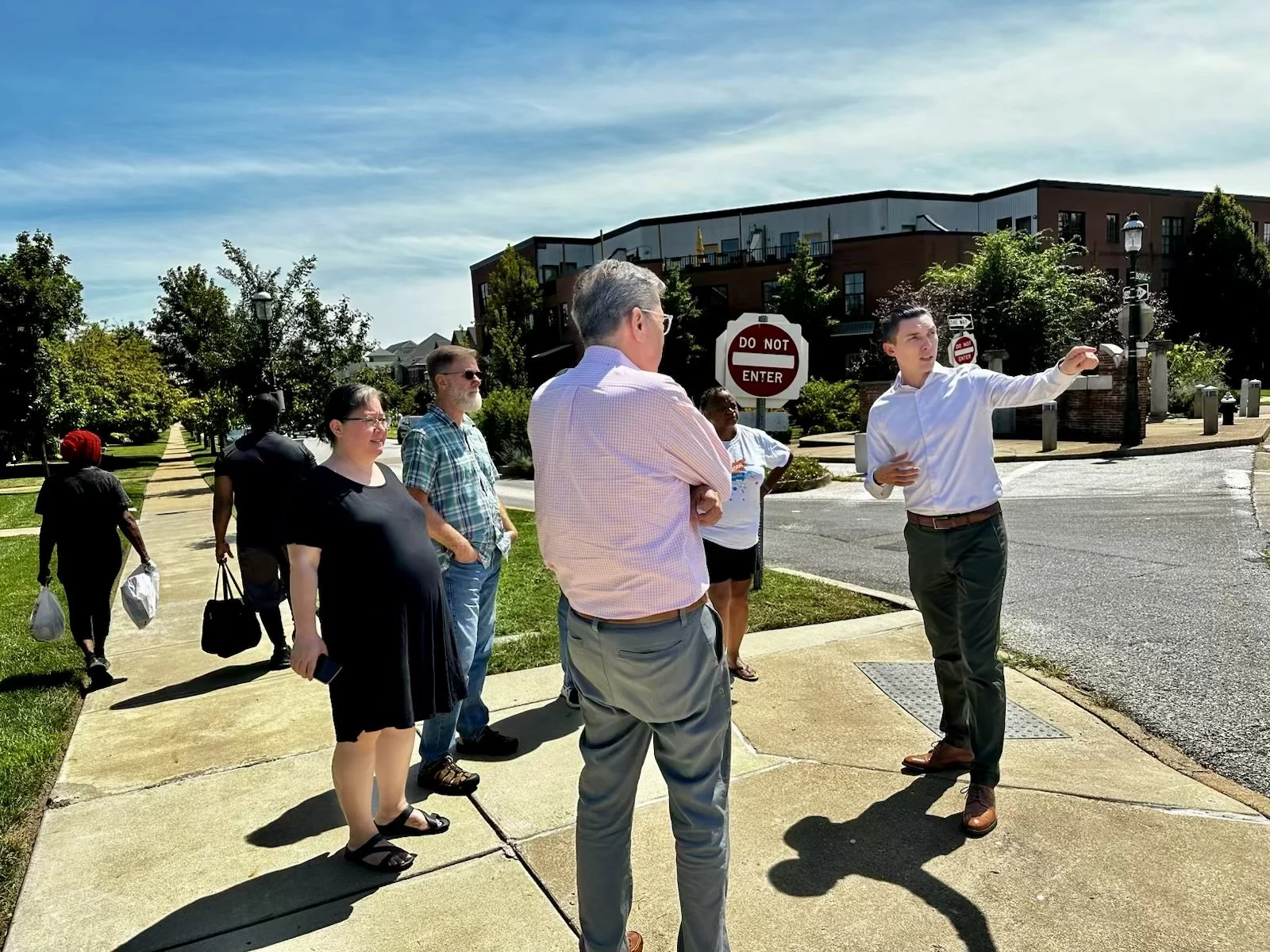
I met with neighbors earlier this year to discuss the need to reduce the number of lanes and improve the safety of the intersection at Olive. Soon, I will be consulting these neighbors again on a proposed plan.
Kingshighway Boulevard
Improvements on Kingshighway will be here very soon. You can already see some construction occurring at the intersections with Lindell and Oakland. Those are improvements like pedestrian islands, funded as part of the ARPA projects. I’m told paving is scheduled for this Spring. The construction site at Lindell and Kingshighway has caused some safety concerns, and there are plans to address those as well after the City completes its work on the intersection.
Conclusion
Thanks for taking this deeper dive into some of the things I’ve worked on in 2025. As always, you can reach me at BrowningM@StLouis-MO.gov for anything government related, and MBrowningSTL@gmail.com for anything campaign related. I look forward to continuing to serve the 9th ward and the City of St. Louis in 2026!
