
August 2026 Policy Newsletter

The Board of Aldermen is on summer break, but the first half of our ‘26/’27 session was busy. We passed a budget that was more difficult than past years with the police takeover by the state, a water rate increase that was necessary to save the Water Division from bankruptcy, and we finally passed a bill to spend the Rams Settlement money. But one issue wasn’t resolved before the Board went on summer break.
The long legislative break in the summer is partially necessary because the full board chambers do not have air conditioning. Nonetheless, we held some special meetings to discuss this hot issue:
Data Center Regulations
The Board of Aldermen is currently debating regulations around data centers, a pressing topic in St. Louis ever since a large, 120 megawatt (MW) data center in Midtown was proposed and approved by the Board of Public Service earlier this year. I’ve written about my opposition to that project and the reasons why, and even though the details have changed slightly, I still think it should not have been approved before regulations have been finalized. Under the proposed regulations, that data center would have faced a much tougher road to approval.
Over the rest of this newsletter, I’ll discuss how we got here, what are in those regulations, why I am co-sponsoring them, what has happened as they’ve worked their way through the process, and most importantly: what will happen next.
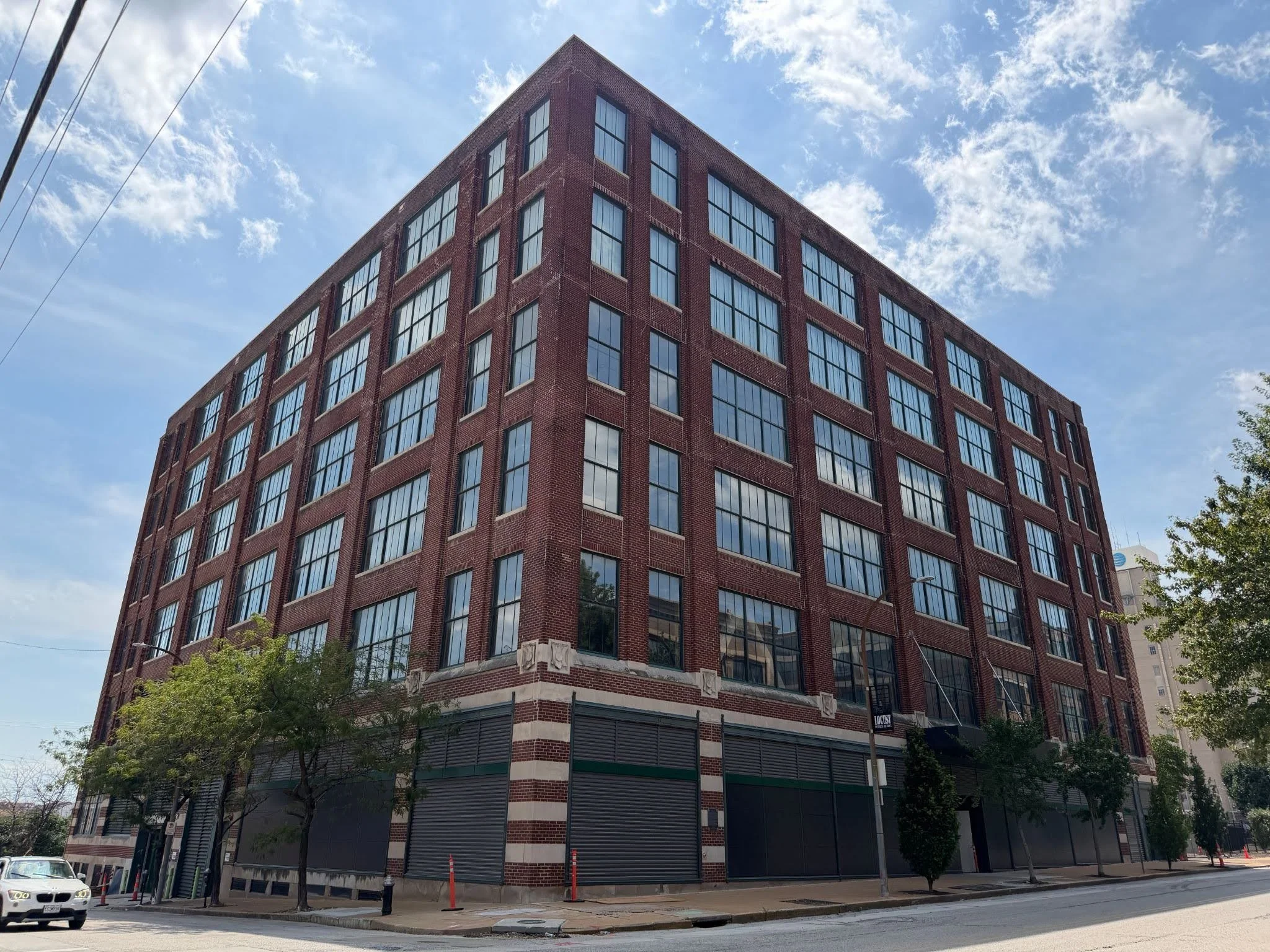
The exterior of a data center in Midtown, where the ground floor is completely absent of activity
How We Got Here
In September 2025, Mayor Spencer signed Executive Order 92, directing City departments “to develop thoughtful frameworks for incorporating data centers.” Shortly after, the Board of Aldermen voted 10-2 to pass Resolution 111, affirming support for the executive order, and further “directing the creation of a thoughtful and comprehensive framework regulating data centers in the City of St. Louis.”
Over the next 10 months, staff from several City departments, including Planning, Zoning, and the Office of Sustainability, worked to understand the land use implications of a rapidly evolving industry and how it might affect our residents. They evaluated the data centers that already exist within the City, reached out to other cities about their experiences, and spoke with experts and stakeholders. From there, the goal was to write regulations that protect the interests of the public first, while also recognizing the benefits, including the significant potential tax revenue.
The Planning Department compiled their findings and recommendations into a report which was submitted for discussion and review to the Planning Commission, which is a body made up of city residents, city employees, and elected officials, including Alderwomen Anne Schweitzer (Ward 1) and Alisha Sonnier (Ward 7).
The Planning Commission held public hearings on February 11th, May 18th, and June 10th, taking in testimony that ranged from supportive to oppositional. The public testimony during these meetings, as well as written testimony provided through a variety of formats, informed the approach to the regulations as the Planning staff continued to make refinements, presenting on adjustments in each meeting.
On June 10th, a formal recommendation for data center regulations emerged from the Planning Commission on a unanimous vote. While they were not an outright ban, as many residents wanted, the regulations set very high standards for the largest data centers, which have the biggest impact on the City and its people. The Planning staff released this framework to explain their reasoning behind the regulations in what would become Board Bill 49. In that memo, they said: “The regulations outlined do not comprise a ban. However, staff has received very consistent feedback from industry experts that the standards are very high—especially for larger data centers—and will be challenging to achieve. This is intended to balance the City’s desire to both diversify and strengthen its tax base, while also protecting residents and other long-term development and community priorities.”
On June 18th, the regulations arrived at the Board of Aldermen. The BoA’s Housing, Urban Development, and Zoning (HUDZ) committee met four times between June 23rd and July 7th to discuss the bill and make additional amendments. In committee, the amendments reflected engagement from Ameren, our local electric utility provider, with a better understanding of the terminology around renewable energy credits (RECs) and how to best calculate energy demand. Additional amendments strengthened some of the application and reporting requirements. Overall, the committee amendments strengthened the bill, protecting the interests of the public, and it passed out of committee by a vote of 6-0.
Following the committee amendments, the bill was referred back to the Planning Commission for a fourth public hearing on July 9th where they voted unanimously to support the bill as it was amended in committee. Once again, they heard from the public. Not everyone was happy, and some continued to push for a ban, while others argued that the regulations were too burdensome for the larger data centers. At that point, Board Bill 49 was a compromise, allowing data centers to be built in our City but regulating them like any other industry. Every rule and every regulation was designed with people in mind, recognizing the benefits and drawbacks that these facilities represent. Things that had greater potential for harm were regulated more heavily. We get the City we plan for, and our Planning staff makes their recommendations with deep knowledge, extensive engagement, and a mind towards what is best for our City now and into the future.
What is in the Regulations?
The legislation that made it to the full floor of the Board of Aldermen included a framework that differentiated data centers by power use, separating them into three categories based on megawattage: Micro (less than 5 megawatts), Standard (5 - 30 MW), and Major (30 MW or more, capped at 500,000 square feet). This is a smart way to differentiate data centers, because they have different effects depending on their size, and power consumption drives the biggest of those effects like noise, heat, and other external effects of data centers on our city. The regulations also limited data centers to certain locations based on their size, restricting them to zoning districts H - L, which are mainly commercial and industrial areas.
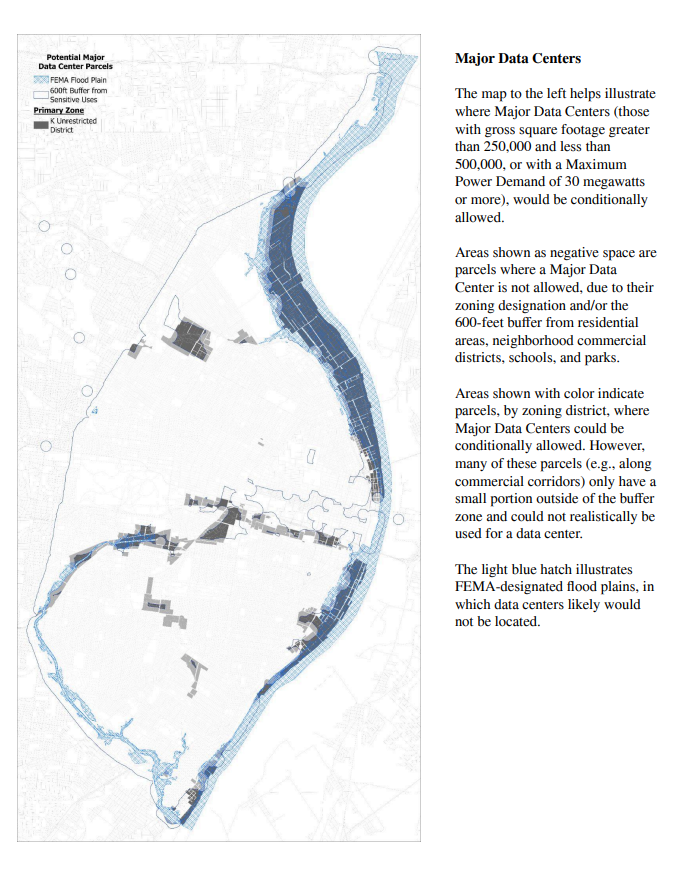
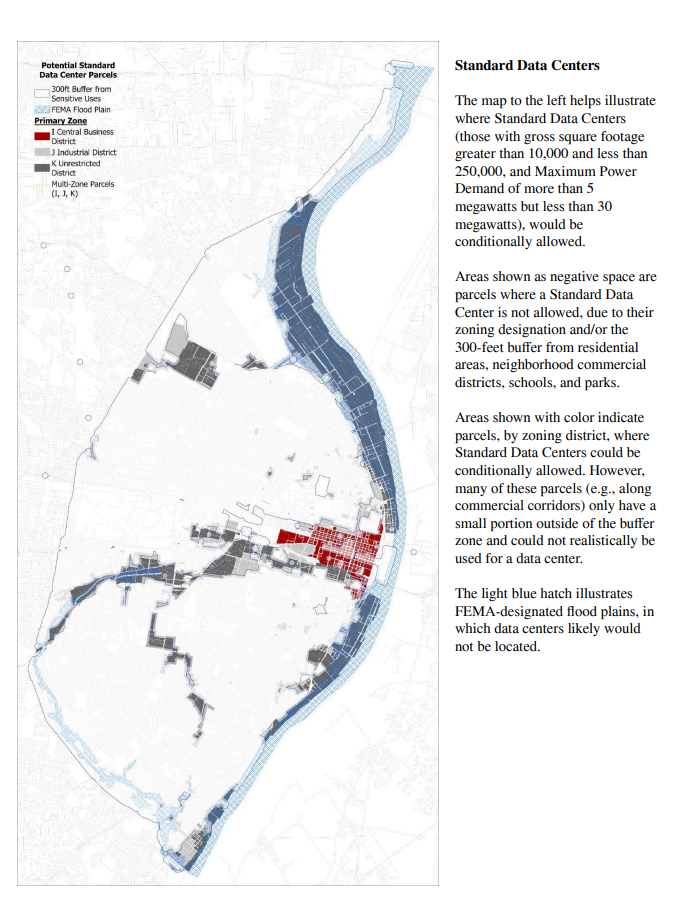
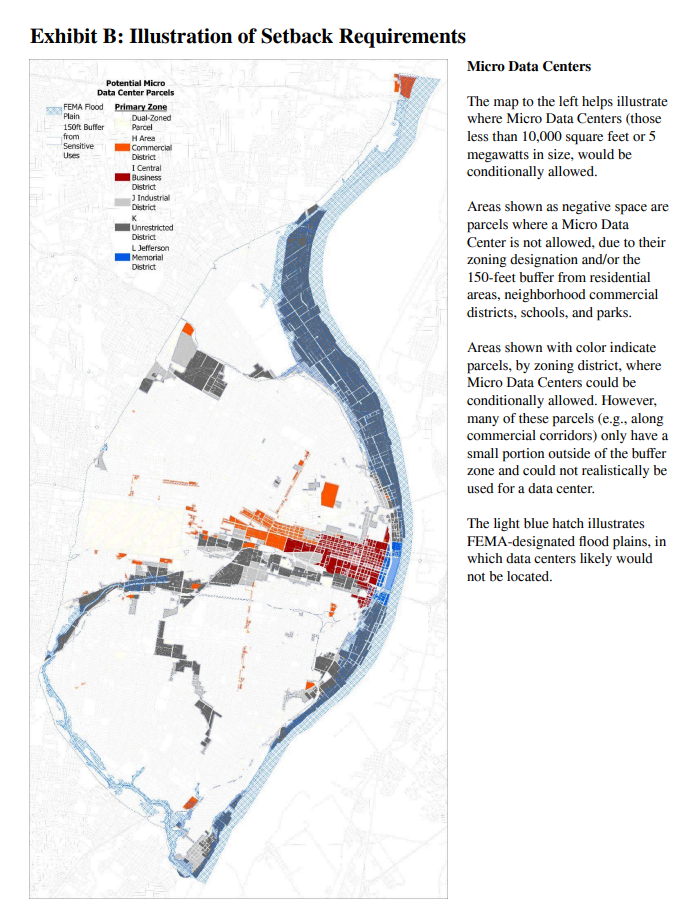
Zoning Guidance from Planning Department June 10, 2026 Report
Data centers don’t provide the kind of hustle and bustle that bring vibrancy and life to cities, and they also aren’t the most desirable neighbors. They often have back-up generators on site, produce a lot of heat, and require beefed up electrical infrastructure. Sometimes they can be loud, generating unpleasant sounds for long periods of time. As a building, they aren’t something that the public can visit, and even walking by, they aren’t much to look at, often looking like windowless warehouses. There aren’t many workers on site, meaning there aren’t people going out to lunch or grabbing drinks after work at nearby local restaurants, which is what Downtown businesses really need. Because of these downsides, the drafted regulations sought to mitigate some of these issues, like requiring large setbacks from residential and commercial areas to protect against noise pollution, heat, and preserving walkability, a key element in successful cities. For Downtown, the regulations included rules that were aimed at preserving density by not allowing more than 30% of a building to be used as a data center if it is within 300 feet of another data center.
Data centers also consume a massive amount of electricity. The 120 MW data center in Midtown that was recently approved will consume the same amount of electricity as 80,000 homes. The proposed regulations in Board Bill 49 include renewable energy requirements, through the use of bundled and unbundled renewable energy credits, which are tied to renewable energy production.
The demand for data centers is spiking nationwide, but all of that electricity is not currently available and will need to be produced. In St. Louis, it will be produced by Ameren, the region’s largest electricity utility and a private company. While bound by Missouri law to provide enough electricity for all customers, they are hard at work building new power plants, not with renewable energy, but by burning fossil fuels. They’re currently building their largest natural gas power plant. Thanks to Missouri Senate Bill 4, Ameren can now charge you on your electric bills for the construction of new power plants, even though they aren’t even producing power yet.
In a City that already experiences an urban heat island effect, we’re seeing hotter, longer summers and more volatile weather patterns. St. Louis City isn’t going to stop climate change by itself, but we can make sure that the energy we consume is produced sustainably so that we aren’t making the situation even worse, and that’s why the data center regulations recommended by the Planning Commission included strong renewable energy requirements.
The overall regulations are worth taking a look at, and if you dive into them, you will see that they are thoughtful, placing our city and our people first in the face of a rapidly developing new industry.
The current situation
As mentioned earlier, our Planning staff took a look at the data centers that currently exist in St. Louis City and the region. In my mind, those buildings actually prove the point of why regulations are necessary. To understand the concerns, all you need to do is go walk by one of the existing data centers Downtown. Along Tucker Blvd, two data centers have ground floor windows covered in peeling vinyl. One of them, the Netrality building, sits next to SLU Law School, and is one block from City Hall. Around the corner on Olive, Tierpoint operates a building that occupies half the block but offers a windowless ground floor with no visible activity. Farther up Tucker, the Globe building is another data center, quietly operating, but with no discernable activity inside or out. All of these data centers would qualify as “standard” under the current regulations, under 30 MW. But are empty storefronts considered vibrancy? Is this the Downtown that we are investing $55M of Rams money in to revitalize?
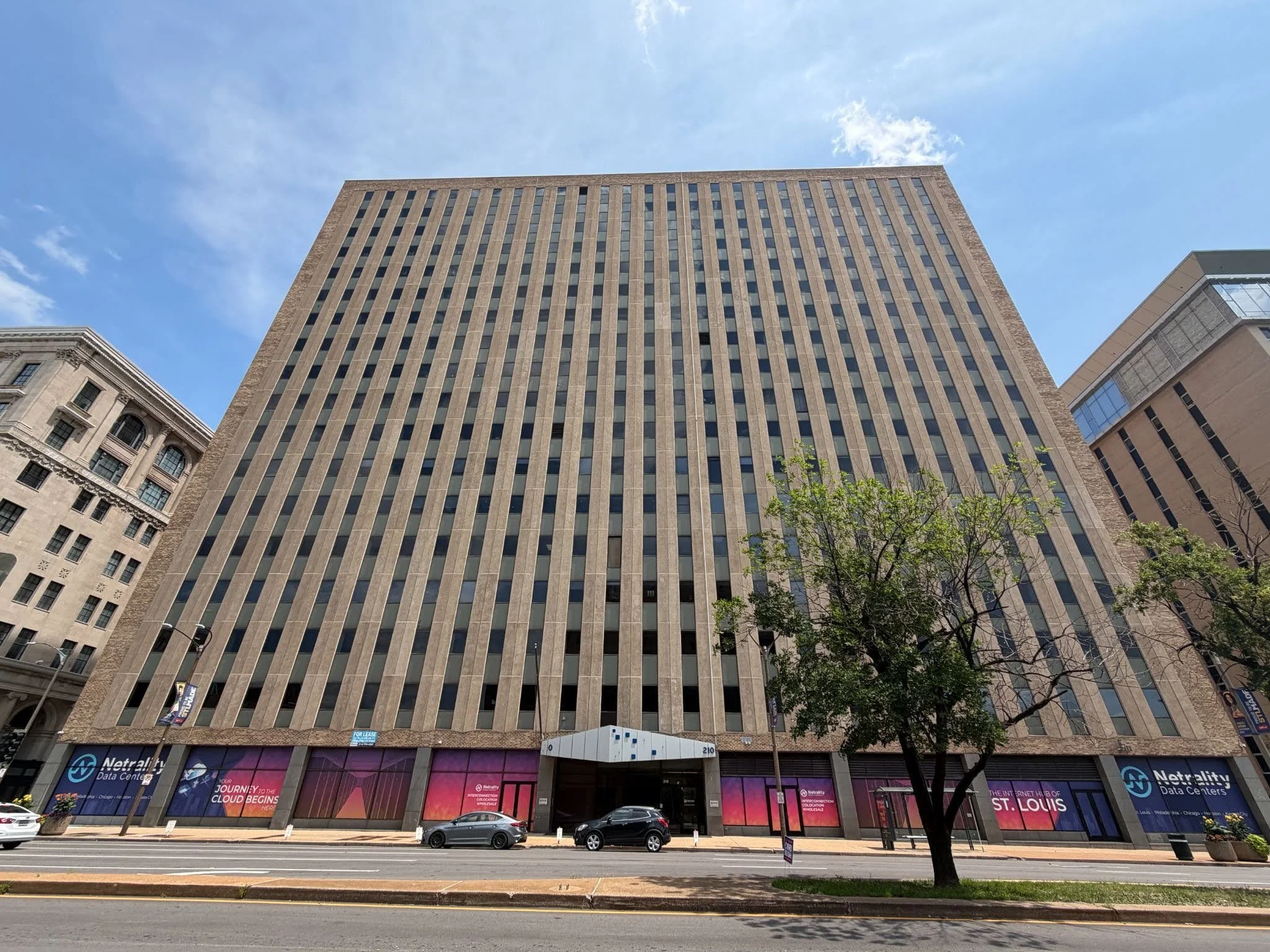
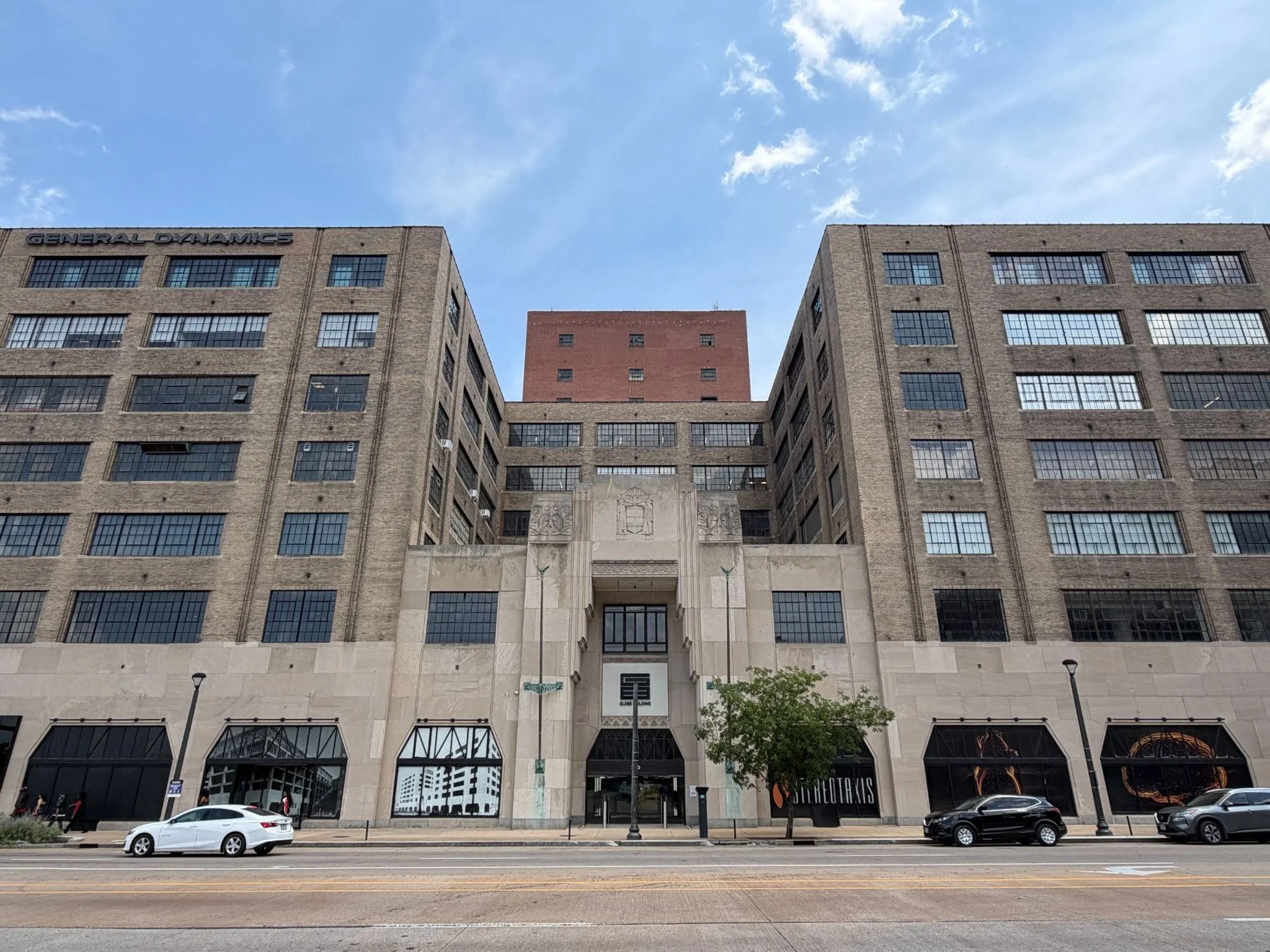
(Left) Netrality’s building on North Tucker, where the lobby comprises the entire ground floor and features windows covered in vinyl with little activity coming in or out of the building. (Right) The Globe building on North Tucker used to be a local newspaper. Now its ground floor features windows covered in vinyl wrap, and the once busy building sits largely empty of people
I’ve toured a data center out in St. Louis County. It was a small one, under 5 MW, so it was not loud. But it was also quiet in the sense that it only had a handful of employees. One of them joked that it was nice to see us on the tour, otherwise they wouldn’t have seen anyone all day. What’s more, it was located in an industrial park, with a large berm shielding the nearest homes from it, which were over 700 feet away. The Midtown data center will be more than twenty times larger, and much closer to people’s homes. What people who pitch data centers fail to mention is that the cities who have made the most of data centers often have them located outside urban environments, where land is plentiful and commercial and residential areas are far away.
When our City’s Planning staff worked on these regulations, they addressed the way data centers can best fit into our City. They didn’t make it impossible to build them, but made sure that if they are built, they are built and operated without being detrimental to the people who call this place home.
The latest
On Monday, July 20th, the full Board of Aldermen met in a special meeting to perfect Board Bill 49. Over a contentious three and a half hour meeting, three amendments were made that weakened the proposed regulations. These amendments were:
Removal of the 30% cap on data centers within 300 feet of each other, allowing for denser data center development Downtown.
Gutting the renewable energy requirements, allowing them to be waived if the electric utility and the data center deemed them too difficult to follow.
Allowing “institutional campuses” to have micro or standard data centers within the buffer zones intended to protect residential areas.
I voted against these amendments, pointing to the hard work done by the experts in our Planning and Zoning departments. When regulations are written to protect the public, I will always stand with the people. Data centers may have an economic benefit, but they should not come at the cost of our people and their wellbeing or the vibrancy of our City.
The density requirements are important. In a city with a declining population, we cannot hope to reverse the decline of our tax base by filling buildings that once held people with machines. We won’t create a Downtown that is vibrant if our largest buildings are data centers that contribute little activity and almost no people.
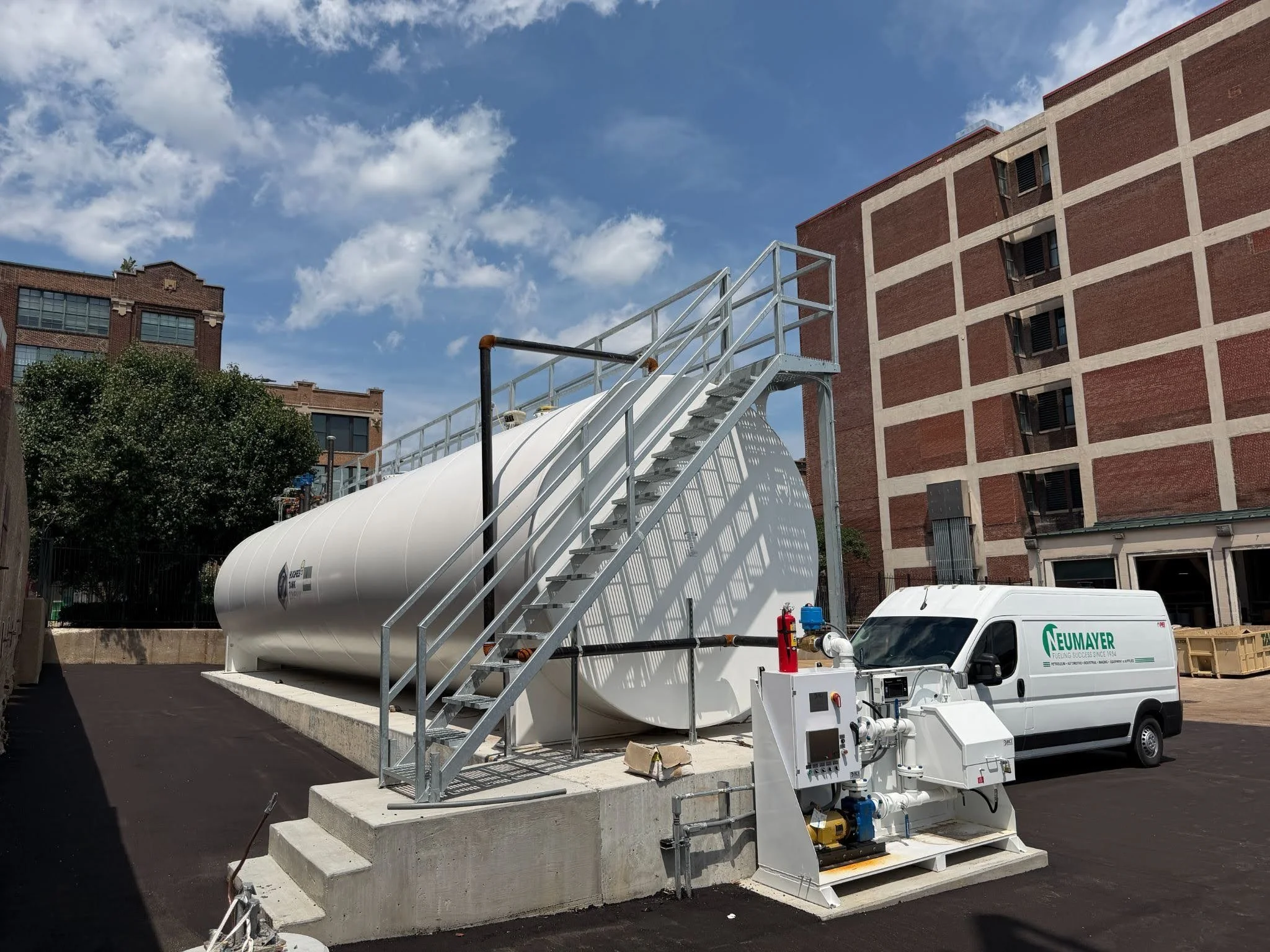
The 30,000 gallon diesel fuel storage recently installed at the data center (right) on Locust. Tierpoint has indicated that they will be constructing a structure to hide it from view.
Our adopted climate goals are important. Future generations are depending on us. The current population in St. Louis would love it if it cooled down a little. If we don’t take emissions and pollution seriously, we will continue to see the disastrous results of climate change close to home. The energy consumption by data centers is unlike most other uses in our City. Your electric bill is already going up as Ameren builds out the infrastructure necessary to meet the demand. If a data center cannot adhere to renewable energy requirements, it should not be allowed to proceed without paying the penalty. An exception like this would benefit the largest, most power hungry data centers: the “major” data centers that are opposed by the vast majority of the public. Even our own planning staff have said that these major data centers have no place in an urban environment.
I also opposed the amendment for “institutional campuses,” ostensibly for medical centers. The reason I opposed the amendment is because the medical centers themselves, including the one I represent, did not request that any exception be made for them. Alderwoman Sonnier confirmed that SLU also did not ask for an exception, so it begs the question, if it isn’t for Washington University, and it isn’t for Saint Louis University, which medical institution is it for? But that amendment passed comfortably, too, despite both of us raising that point. Our Planning staff had already engaged with WashU and SLU during the drafting process to make sure that these regulations wouldn’t interfere with important, life-saving research and data storage.
At the end of the debate, after the amendments weakening it passed, the bill was placed on the informal calendar, meaning the progress of the bill was paused until it is put back on the regular calendar. This was done because changes to zoning legally must follow a different approval process that includes the input of the Planning Commission. The same thing happened after the amendments in committee. Substantive amendments made on the floor of the Full Board required the bill to return to the Planning Commission for a public hearing, and so the bill headed back to the Planning Commission, and they met for a fifth time on August 12th.
The Planning Commission heard public comment, debated the amendments, and voted to reject two of the amendments outright. They first rejected the amendment removing the 30% cap meant to protect the density of Downtown. Commissioner Jake Banton, a resident member of the Planning Commission, put it well when he said “we’re talking about, in the current zoning code, districts H, I, and L, which is the narrow central corridor band stretching from the Central West End to the Arch…some of our most vibrant as well as potential highest density neighborhoods that we have in the City…personally, I think that a 30% cap as well as the current regulations limiting or requiring certain active ground floor uses is incredibly important to further develop these areas of the City. We need to be promoting people in this area.”
The Planning Commission also rejected the amendment that allowed for a waiver on renewable energy requirements after the Sustainability Director, Elysia Russell, testified that data centers will set us back on our climate goals. The Commission agreed that it is essential that we push for renewable energy if we are allowing such large power users to operate.
Finally, on the amendment concerning medical institutions, the Planning Commission recommended a change to the wording, adding some clarity and protecting against misuse. The meeting was then recessed after some confusion from a late text by an unnamed city official, but the recommendations from the Planning Commission were ultimately unchanged, and the bill will head back to the Board of Aldermen.
Conclusion - Who We Build Our City For
As the Board was debating weakening these regulations, I said don’t know who we are building this city for when we’re making it easy to build data centers and hard to build housing.” The future of our City is being decided, and we need to decide if it’s for us, or for someone else. We ought to choose ourselves, and say loudly that if the future includes data centers, they need to be built sustainably, on our terms, and in ways that don’t take away from the vibrancy of our city.
I have been consistent on this issue because I believe our city’s most important asset is its people. It will not matter how much tax revenue we get if we don’t have people to live in our City, visit our businesses, and do the necessary work to help keep our neighborhoods thriving. If we create an urban environment that is inhospitable to people, void of human activity, and power hungry to the point that it makes our lives unaffordable, we’ve failed our core responsibilities as representatives.
There are still a lot of good protections in Board Bill 49. I am a proud co-sponsor because we don’t have any regulations in place right now, and we need them sooner than later. Our Planning staff has put in countless hours to actually understand this subject, and our Planning Commission, including Alderwoman Schweitzer and Alderwoman Sonnier, do not deserve to have their work undone. It is imperative that we have regulations that center the people that live here first and foremost.
On Friday, August 28th, the Board of Aldermen will meet again to discuss Board Bill 49 at 10 am in the full board chambers at City Hall. We will decide whether we are going to override the recommendations of our planners, or if we are going to stand with the people.
Thanks for taking the time to read this month’s edition of the policy newsletter. As always, you can reach me at BrowningM@StLouis-MO.gov for anything government related, and MBrowningSTL@gmail.com for anything campaign related.
