
March 2026 Policy Newsletter
Vote for Prop E, then come to my next town hall
First things first: we have a very important election coming up. Election Day is April 7th, and the only thing on the ballot is the renewal of our St. Louis City earnings tax. This 1% tax makes up a third of our city’s revenue. It is essential to our City, funding everything from first responders to trash pickup, street paving, and more. You can early vote at Schlafly Library, during the following hours:
Monday: 1 PM - 5PM
Tuesday through Thursday: 11AM - 5PM
Friday: 11 AM - 4:30 PM
Saturday: 11 AM - 4:30 PM
Sunday: Closed
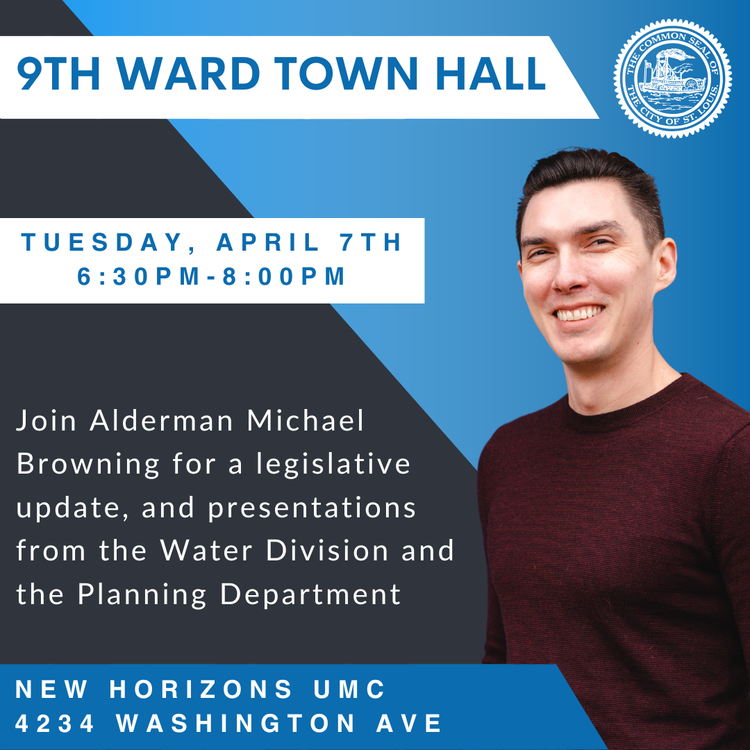
Or you can vote on election day, April 7th, 7 am to 7 pm. Then, from 6:30 pm to 8 pm, come to my town hall at 4234 Washington Blvd, New Horizons UMC. Our guest speakers will include someone from the Water Division to discuss the ongoing rate study, and someone from the Planning and Urban Design Agency to discuss the new zoning update (ZOUP). I don’t want to see anyone at the town hall that hasn’t already voted for Prop E. So go vote, then come to the town hall. See you next week!
Water Update
In my January newsletter, I focused on the woes of the Water Division. To catch up on this subject, check out my last newsletter on the Worth of Water. The short version is this: the Water Division has not been well funded over the last decade and a half. It’s an Enterprise Fund, meaning it gets its money from the bills people pay, and not from the City’s taxes. Before 2024’s overdue rate increase, the last time the rates increased was in 2013. Since then, our infrastructure has continued to age, and amid understaffing, increased costs, and a recent moratorium on water shutoffs, the Water Division has burned through its contingency fund just to keep our system running. At one point in recent months, over 16,000 customers were not paying their water bills, and the Division was missing $14 million in revenue from those delinquent accounts. The moratorium was lifted late last year, rates were raised in two stages, but perhaps unsurprisingly, the Water Division is still in need of major investment. Per the update we received in January, their deficit stood at $8 million.
Since then, we got to work on a plan to save our water. Through communication with the Mayor’s Office, American Rescue Plan Act (ARPA) funds were identified to help as a short term solution to this year’s deficit, and the beginnings of a long term funding plan have started to take shape.
Board Bills 160 and 161 were introduced in February by Alderwoman Anne Schweitzer, who has long been a champion for our Water Division. BB160 allocated $1.2 million in ARPA interest money, and Board Bill 161 re-allocated $6.8 million that had been identified as at risk of going unspent by the end of 2026, the federal deadline to spend ARPA funds. Together they represented an $8 million dollar investment, enough to plug the hole for this fiscal year. Both bills were sent to the Housing, Urban Development, and Zoning (HUDZ) Committee, where a debate ensued on whether it was an accurate accounting of allocations that couldn’t be spent in time. By the time BB161 left committee, the planned $6.8 million was whittled down to $5.4 million.
Meanwhile, over in the Public Infrastructure and Utilities committee, we heard the latest update from our Water Division, who told us that the January storms had taken a toll on our infrastructure, and the deficit had grown. Board Bills 160 and 161 were allocating $6.6 million after reductions in the HUDZ committee, but the deficit was now $10 million. The problem was growing, and the help was shrinking. The Board finally passed assistance for the Water Division in mid-March, staving off disaster for a few more months. The Water Division’s problems remain, and will persist without further action from the Board of Aldermen soon.
Our Water Division is publicly owned, meaning it belongs to you, the residents of St. Louis. We get our electricity from Ameren, our gas from Spire, and the Missouri Sewer District owns our sewers, but we own our water. It is up to us to make sure that safe, clean water makes it to every home, business, school, park, and the 15,500 fire hydrants in our city every day. I’m calling for at least $55 million to be invested from the Ram’s Settlement Fund in addition to what the rate sufficiency study ends up recommending.
The Water Division will be holding two town halls to discuss their future plans, including the ongoing rate sufficiency study.
April 8th, 5:30 pm - 7:30 pm
ArchWell Health Center, 1315 Aubert Ave
April 16th, from 5:30 pm - 7:30 pm
Buder Library, 4401 Hampton Ave
Both town halls will be broadcast on STLTV.
BB167
The end of session at the Board of Aldermen is always a busy time. As the Board goes through its final meetings before we begin a new session, bills are introduced and rushed through the process to beat the deadline to pass them. Sometimes Alders wait to introduce controversial bills to escape the extra scrutiny that a drawn out timeline might allow. Such was the case with Board Bill 167, a bill to create an exemption to the 2009 Smoke Free Act and allow smoking inside America’s Center, St. Louis City’s main convention facility.
The bill was introduced by Alderman Rasheen Aldridge and co-sponsored by Alderwoman Jami Cox-Antwi. Its stated purpose is to attract a Premium Cigar Association conference that is currently only able to be held in Las Vegas and New Orleans. It narrowly passed the full Board of Aldermen, with the body almost evenly split over the controversial bill. I voted no, along with Alders Anne Schweitzer, Shane Cohn, Daniela Velazquez, Pam Boyd, and Sharon Tyus. Alderwoman Clark-Hubbard abstained, and Tom Oldenburg, Bret Narayan, Matt Devoti, Alisha Sonnier, Jami Cox-Antwi, Laura Keys, Rasheen Aldridge, and President Megan Green voted to allow smoking in a public building.
How did we get here and why are we moving backwards? I can’t speak to the motivations of my colleagues, but I can speak to the history of smoking ordinances in St. Louis City.
The debate truly kicked off in 1989, when Alderman Freeman Bosley Sr. suggested a smoking ban within City Hall, specifically the Aldermanic hearing rooms. At the time, smoking was common in City Hall, including on the floor of the Board of Alderman and in the hearing room where bills were heard in committee. It was a small step, but one that he felt was important. He said at the time: “If we aren’t willing to bite the bullet in City Hall, we can’t very well try to instruct the public.”
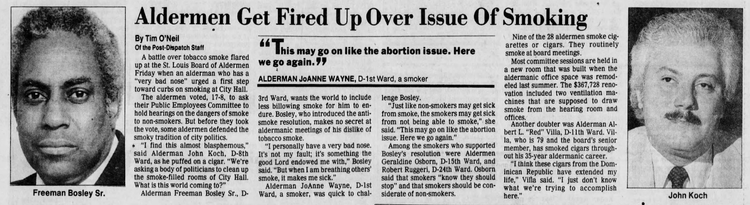
St. Louis Post-Dispatch May 20, 1989
There were several attempts to ban smoking in City Hall, but it wasn’t until 1991 that the Board of Aldermen banned smoking in city-owned buildings. It was not a total ban, designating certain areas as non-smoking but still allowing people to light up in other areas. The Board wouldn’t ban smoking in all areas of all city-owned buildings until 2003. Over the next several years, Aldermen including Daniel McGuire and Lyda Krewson would try to expand the smoking bans.
It wasn’t until 2009 that Lyda Krewson achieved a monumental step forward, passing the Smoke Free Act and banning smoking in most public places. The act was effective January 1st, 2011, and it only identified a handful of exceptions where smoking was allowed, including private residences, private clubs, outdoor areas, tobacco retail stores, and casinos. Some bars could allow smoking for five years before even those exceptions sunsetted.
There has been a long, linear history, moving in one direction, and that has been in the direction of progress, banning smoking in the interest of public health throughout our city. First in the Board of Aldermen chambers, then in City Hall with exceptions, then in public buildings, then in private establishments with limited exceptions, many of which expired after five years for the most part. The design was that fewer exceptions would be allowed in the future, not more.
I understand the desire to bring more people to our city, to experience everything great about St. Louis and contribute to our economy. I want St. Louis to be known for many wonderful things, but ruining our public buildings with cigar smoke is not one of them. I want St. Louis to be known for curing cancer, not allowing things that cause it.
Board Bill 167 is written so broadly that it could allow smoking of more than just cigars in other public places, as the bill didn’t bother to define “convention facility.” Hotels host conventions too (I attended a convention at Union Station just last year). The Stifel Theatre was the City’s original convention facility. As BB167 is written, a convention facility (undefined) may host a “time-limited, private and ticketed, specialized convention involving on-site smoking activities upon satisfaction of all requirements set forth” in the bill.
The requirements listed include the installation of a “temporary or permanent ventilation and air filtration system designed to capture and exhaust tobacco smoke.” But a WashU study from 2013 notes that “ventilation systems are not effective in removing SHS (second hand smoke) from the air. Therefore, no policy should be adopted that exempts establishments based on the presence of ventilation systems,” the study concluded.
The City spent millions of dollars to upgrade America’s Center after the Rams left. We wanted to make the Dome and its attached convention center a more attractive venue for conventions and conferences, but the Board of Aldermen is reversing decades of progress by allowing smoking in that public building. If the City wasn’t the one doing damage to itself, I’d say that we should ask for that money back.
We cannot be hypocritical, and make exceptions for ourselves while telling private establishments what they can and cannot do. We cannot say we are for workers and then roll back the regulations that protect their health. We should not go backwards, undoing the work of previous alders like Freeman Bosley Sr., Dan McGuire, and Lyda Krewson, who did the hard work of moving our city forward.
I spoke against this bill on the floor, and I lobbied my colleagues. I voted no. The bill passed anyway, receiving a lot of debate, but the health risks of smoking are not up for debate. At the end of the day, smoking is a personal choice, but second-hand smoke is not. That’s why we ban it in public places.
The Premium Cigar Association has its conventions booked in Las Vegas and New Orleans through 2029, but St. Louis has compromised its values to be considered for 2030. There is no guarantee they will decide to come here, just like there’s no guarantee for your health if you work at America’s Center. St. Louis City is always changing, but I believe in growing our city in a way that makes it a healthy, vibrant place. The point of the cigar convention is to sell more cigars. If you want to buy them, that’s your choice, but it doesn’t need to be public policy to support something we know is harmful.
Conclusion
Thanks for taking the time to read this month’s edition of the policy newsletter. As always, you can reach me at BrowningM@StLouis-MO.gov for anything government related, and MBrowningSTL@gmail.com for anything campaign related.
